Dr. Peter R. Jørgensen is a geologist and has 40 years of experience as geoscientist specialized in contaminant hydrology. He has been leading groundwater research projects and government consulting projects as associate professor at the University of Copenhagen and Technical University of Denmark, and in private industry as scientist and leader of innovation. In 2011, PJ established "pjbluetech," a research platform for invited scientist with backgrounds in environmental DNA, radiometric dating, CT-scanning, geochemistry, glacial geology, hydrology, biology, and groundwater modeling. Interdisciplinary research by the group led by PJ and funded by the Danish Ministry of Environment investigates subsurface water contamination processes and mechanisms, aiming to describe groundwater vulnerability and develop strategies for protection of drinking water resources against soil pollution. PJ is permanent member of the Ministry of Environments expert group for surveillance of Danish EPA pesticide research projects, and an appointed expert for the Ministry of Environments pesticide registration.
Current research projects
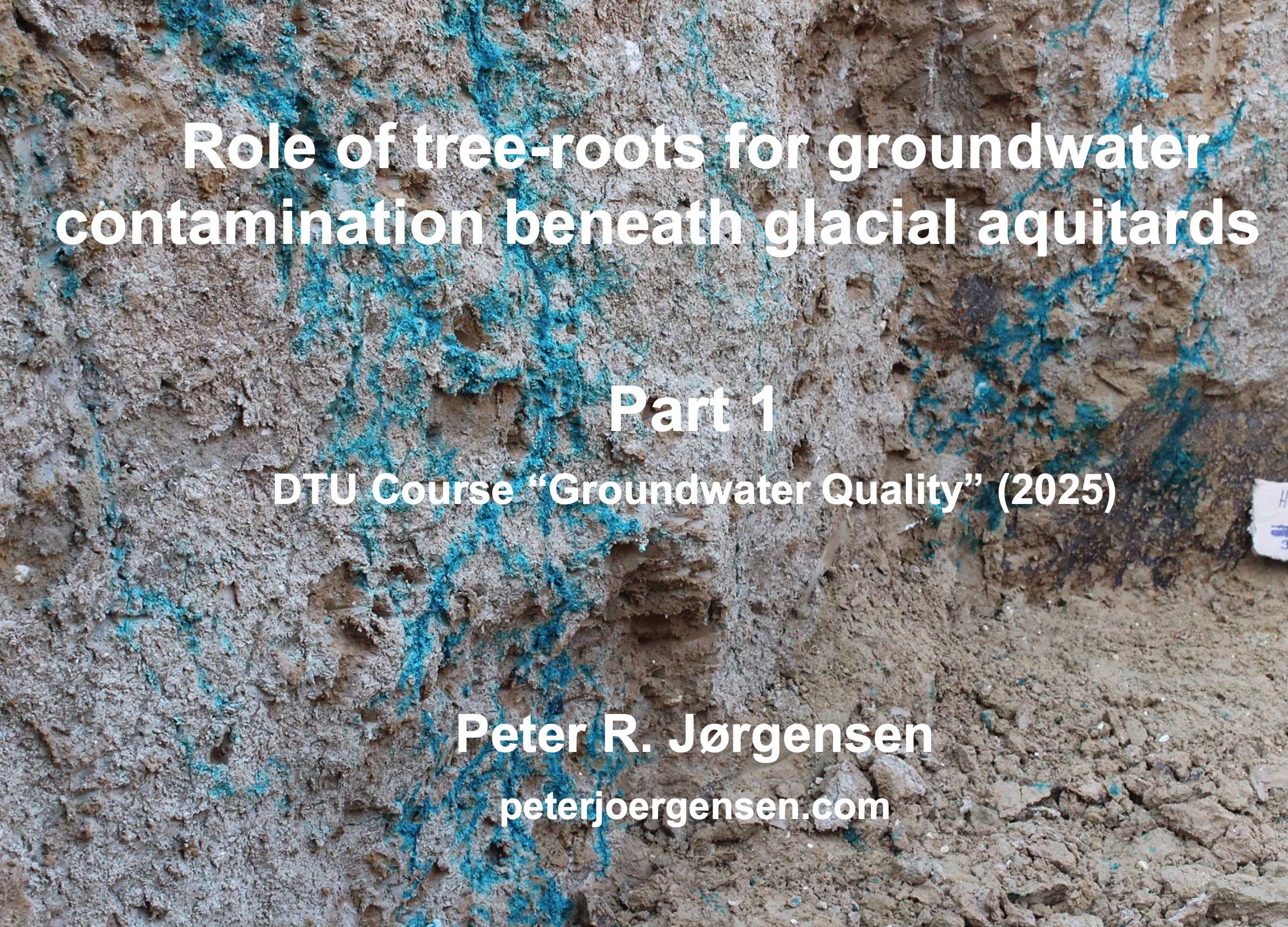
Role and Implications of deep tree roots on groundwater vulnerability beneath clay-rich aquitards
The project utilizes innovative techniques in 15 study sites to directly assess mass transfer in fractures and deep root macropores. This is combined with studies of ancient DNA and other disciplines (radiometric dating, X-ray imaging, geochemistry, and glacial geology) to trace the origin and determine the hydrological role and implications of deep root macropores from trees for groundwater vulnerability beneath glacial aquitards across Denmark.
Pointing out vulnerable areas to groundwater pollution with pesticides in watersheds beneath glacial clayey till surface layers
The project develops an operational concept for pointing out particular pesticide vulnerable areas in watersheds with mixed glacial and post-glacial deposits, and glacial till terminal moraines. The concept utilizes “Danish national groundwater mapping data” collected across Denmark (1999 – 2026). The validity of vulnerable areas pointed out by the concept is tested using CFC and pesticide groundwater monitoring - the latter as blind test after finishing the concept.
Hydrological function of earthworm burrows in glacial till soil in response to agricultural soil management
The study investigates the spatial structure and hydrology of earthworm burrows before and after introduction of different degrees of reduced soil managing. The study is using dye tracer infiltration, smoke-injection techniques, environmental DNA and earthworm monitoring to trace the dynamics of burrowing, macropore structure, and water recharge processes as response to changes in earthworm community controlled by the soil management.
Field experiments of flow and transport of pesticides in clayey till soil and sub-soil to groundwater under natural and forced infiltration as function of soil management and pesticide properties
The study investigates pesticide leaching and impact on groundwater underneath arable land, which is cultivated by conservation agriculture and located on a culmination in clayey till moraine landscape. The field site is sprayed conventionally with a suite of pesticides representing a wide range of transport properties. The leaching and sub-soil migration of the pesticides are monitored under natural and stressed hydrological and climatic condition over several years. Alongside, earth worm population dynamics and changes of macropore hydrologic properties and hydrologic activity are studied after introduction of conservation agriculture. After the field study of the pesticides, conservative tracers and dye tracer are infiltrated and the experimental field is excavated for detailed characterization of the soil and clayey till structures and flow system from the soil surface to permanently water saturated condition at 6 m depth in the clayey till.
Selected recent publications
International Journals
Deep tree roots at risk of accelerating groundwater pollution beneath clay-rich aquitards. P.R. Jørgensen, K. Mosthaf, P.H. Krogh et al. Nature Communications, 2026 (in press).
Earthworm burrows in glacial till soil: Spatial distribution and hydrological function. P.H. Krogh, C.T. Petersen, J. Olsen & P.R. Jørgensen. Ecohydrology, 2026; 19:e70168, https://doi.org/10-1002/eco70168.
Estimation of effective fracture aperture in glacial till by analysis of dye tracer penetration. Ouf M., P.R. Jørgensen, K. Mosthaf, M.Rolle. in Groundwater 59, 2025.
Microbial life in preferential flow paths in sub surface clayey till revealed by metataxanomy and metagenomics. Bak F. C. Nybroe O, Aamand J., Jørgensen P.R. Nicolaisen, M.H, Vogel T.H. & Larose C. in BMC Microbiology, 24, 2024
Transport of Tracers and Pesticides Through Fractured Clayey Till: Large Undisturbed Column Experiments and Model-Based Interpretation. K. Mosthaf, M. Rolle, U. Petursdottir, J. Aamand, P. R. Jørgensen: in Water Resources Research:https://agupubs.onlinelibrary.wiley.com/doi/10.1029/2020WR028019
A Large Undisturbed Column Method to Study Flow and Transport in Macropores and Fractured Media. Peter R. Jørgensen, Klaus Mosthaf, Massimo Rolle: in Groundwater https://ngwa.onlinelibrary.wiley.com/doi/abs/10.1111/gwat.12885
Government research reports
Dybe biopores arealmæssige forekomst og betydning for pesticidudvaskningen mellem jordoverfladen og kemisk reduceret grundvandszone i moræneler 08-05-2017. Rapporten belyser forekomsten af bioporer og sprækker i landbrugsjord, og hvordan disse påvirker udvaskningen af forskellige pesticidtyper ved forskellig jordbehandling: http://mst.dk/service/publikationer/publikationsarkiv/2017/maj/dybe-bioporer/
Ancient Root Macropores and Fractures in Glacial till and Their Contribution to Pesticide Vulnerability of Groundwater in Low- and High-ground Agricultural Landscape: Rapporten belyser forekomsten og oprindelsen af bioporer og sprækker i moræneler på landbrugsjord, og hvordan disse påvirker udvaskningen af pesticider til grundvandet. PESTPORE 2, 17-02-2022: https://www2.mst.dk/Udgiv/publications/2022/01/978-87-7038-376-9.pdf
Mapping groundwater vulnerability to pesticide contamination through fractured clays. Rapporten belyser muligheden for at udpege særligt sårbart grundvand i moræneområder ud fra morænetype. CLAYFRAC, 04-02-2022: https://mst.dk/service/nyheder/nyhedsarkiv/2022/